
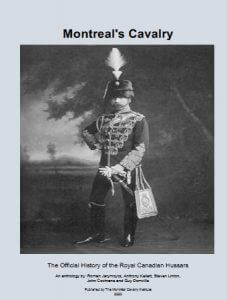
In 2016, The Montréal Cavalry Institute undertook a project to publish a history book about the Montreal-area cavalry and the Royal Canadian Hussars (Montreal). The book recounts a story that is truly unique in Canadian History. The two-volume book, which is expected to range between 800 and 1,000 pages, including multiple appendices, pictures and maps, is expected to be published in 2020.
Volume one of the book starts by describing the activities of the Cavalry troops formed by the French Settlers for the Defense of Quebec and Montreal. It then describes the formation and activities of the Royal Montreal Cavalry under the subsequent English Colonial Regime and describes its role during 1812-14 defense of Canada and the 1837 rebellion. Further, it describes the reorganisation of the Canadian Militia in 1855, and the activities of multiple Montreal-area cavalry troops up until 1914. In this section, it outlines the complicated evolution of the Regiment and its antecedent units – troops and squadrons located in the City of Montreal and across much of south-western Quebec stretching from the Ottawa valley to the Eastern Townships. It describes their training and other activities, their difficulties getting adequate horses, their experiences in providing Aid of Civil Power, their involvement in the defense of Canada during the Fenian Raids, and the participation of their members in the Canadian contingents sent to fight in the South African War. Finally this volume describes the units’ participation in the First World War, principally as the 1st Motor Machine Gun Brigade. The latter unit, a unique formation, was a forerunner of mechanized warfare and blitzkrieg. It acquired the bulk of RCH battle honours for the First World War and featured such great names in Canadian military history as Brigadier-General Raymond Brutinel, CB CMG DSO, and Major-General Frederic Franklin Worthington MC and bar, MM and bar, the Father of the Canadian Armoured Corps.
Volume two of the book starts by describing the activities and evolution of the Montreal-area cavalry units and motor machine gun brigade during the period between 1918 and 1939. It then describes how, during the Second World War, the 6th Duke of Connaught’s Royal Canadian Hussars was deployed to Italy as a division headquarters squadron, and how the 17th Duke of York’s Royal Canadian Hussars was deployed to North-west Europe where it participated in the liberation of France, Belgium and the Netherlands as a division recce regiment. Further, it describes the organisation and activities of these two units after the War and how they evolved to become the Royal Canadian Hussars. It also describe how the unit members participated in various Canadian Forces overseas missions including those in Croatia, Bosnia, and Afghanistan. Finally, this volume will include numerous appendices containing information about uniforms, weapons and other elements that collectors will find very interesting.
The book will published as an official history, with authors, who are all former members of the Regiment, contributing different chapters. Certain chapters were prepared on a collaborative basis. The principal co-authors are:
Roman Jarymowycz, OMM, CD, PhD (McGill). Roman is a retired Lieutenant Colonel, a former commanding officer of the Royal Canadian Hussars (Montreal) and a former Dean of the Canadian Forces Militia Command and Staff College in Kingston. He is a former teacher and historian and has written numerous articles, regimental histories, books on cavalry, including:
Anthony Kellett MA bis (Cambridge, McGill). Anthony is a retired defense department analyst who served in the Royal Canadian Hussars (Montreal) as a captain. He is a renowned historian, international lecturer, and author of two distinguished volumes:
Steven Linton, CD, BCom (McGill). Steven is a businessman and contract specialist, with diverse experience in aerospace and defense. He is a former Commanding Officer of the Royal Canadian Hussars (Montreal) and the author of two brief histories of family members’ experiences in both World Wars, with a limited distribution to family members. During the preparation of the book, he acted as the chairman of the committee of contributing authors.
John Cochrane CD, BBA (Bishop’s), Diploma in Public Accountancy (McGill). John is a retired professional accountant and a certified administrator. He is a former commanding officer of the Royal Canadian Hussars (Montreal) and a former district commander of Montreal militia district number one. He is the co-author of two publication describing the individual and group experiences of members of the Royal Canadian Hussars during deployments in Bosnia and Afghanistan. During the preparation of the book, John also helped with the financial management of the project and with the various reviews.
Guy Domville, who is a former financial advisor and former commanding Officer of the Royal Canadian Hussars (Montreal), who drafted the chapter covering the period from 1985 to 1993.
Other contributors and collaborators included:
The history is more than simply a military record. It is also a contribution to the social and political history of Montréal, Québec and Canada. It sheds light on a currently undocumented part of Montreal’s multifaceted past. Using these militia formations as the basis for their analysis, the authors have aimed to make an important contribution that is innovative, nuanced, and unique.
Since the publication of such a document will not be commercially viable even though the authors are working on a voluntary basis, the Institute needs to finance the costs incurred during the research and writing phase, including research costs, travel, the cost of diagrams, maps and pictures, as well as editing and translation costs. The Institute is hoping to recover a portion or all of the costs of printing and distribution by selling the resulting books at market prices.